Showing posts with label by-product. Show all posts

Saturday, February 7, 2015

Chlorofluorooctane sulfanate (ClFOS or Cl-PFOS) : metabolites or by-product during the production of perfluorooctane sulfanate?

Researchers from the National Research Centre for Environmental Toxicology of Australia used liquid chromatography quadrupole time-of-flight tandem mass spectrometry found some novel fluorinated surfactants in firefighters. The study was published this week at Environmental Science and Technology.

One of the novel chemicals is chlorofluorooctane sulfanate (ClFOS or Cl-PFOS), or one F atom in PFOS get replaced with Cl.

One hypothesis for the origin of Cl-PFOS is due to metabolism of PFOS-related compounds in human body.

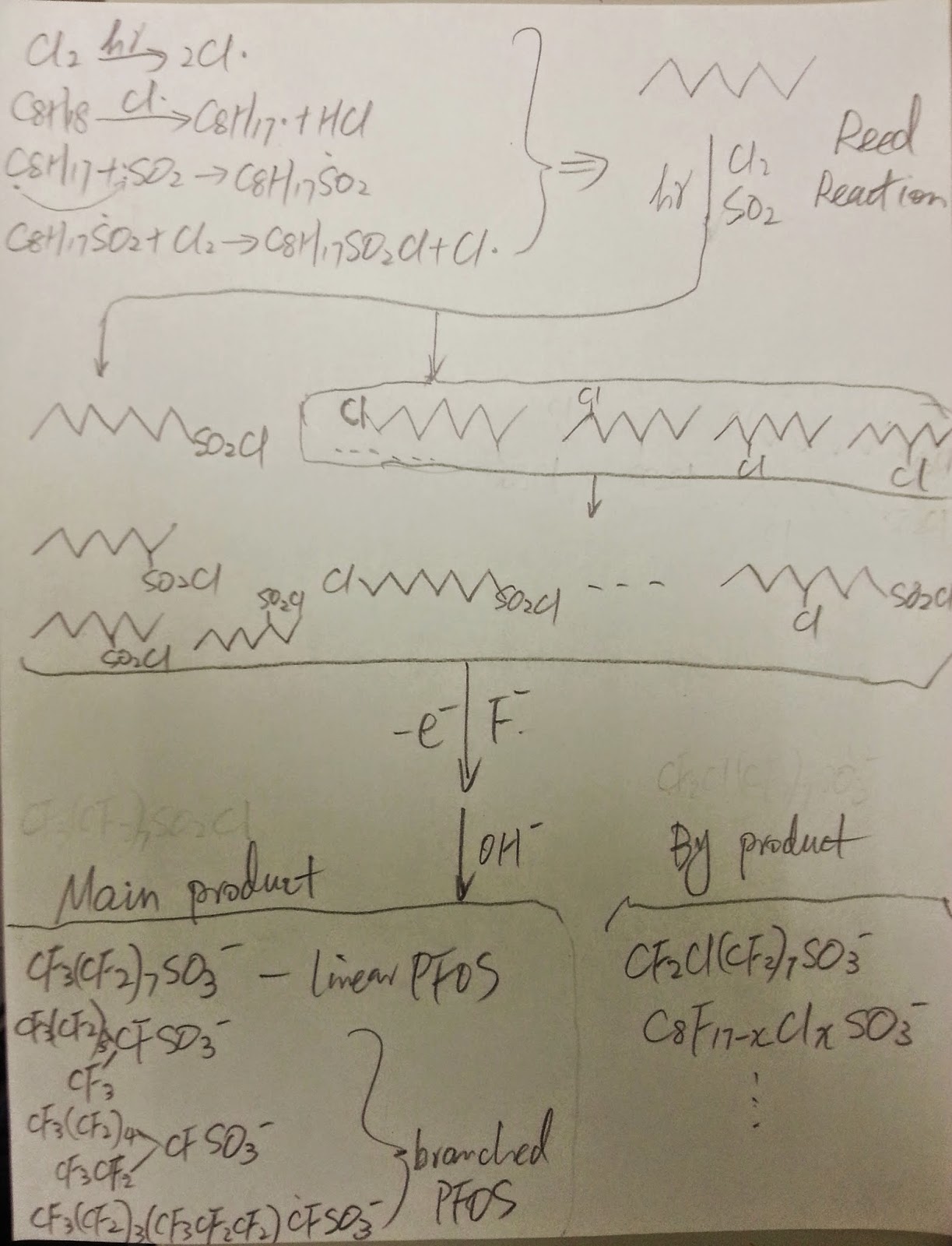
On the other hand,  I think it is plausible that the novel chlorofluorooctane sulfanate is a by-product during the production of PFOS.  Check the analysis of chemical reactions during the production of PFOS:


Thursday, February 5, 2015

Polychlorinated biphenyls (PCBs) in silicone-based adhesives and chlorophenylsilanes

Chlorophenylsilanes are the intermediate substances in the manufacturing of phenyl silicones. As suggested by evidence found in a recent study by Katsunori Anezaki,Takeshi Nakano
polychlorinated biphenyls (PCBs) could be formed along with reactions to synthesize
phenyl silicone.
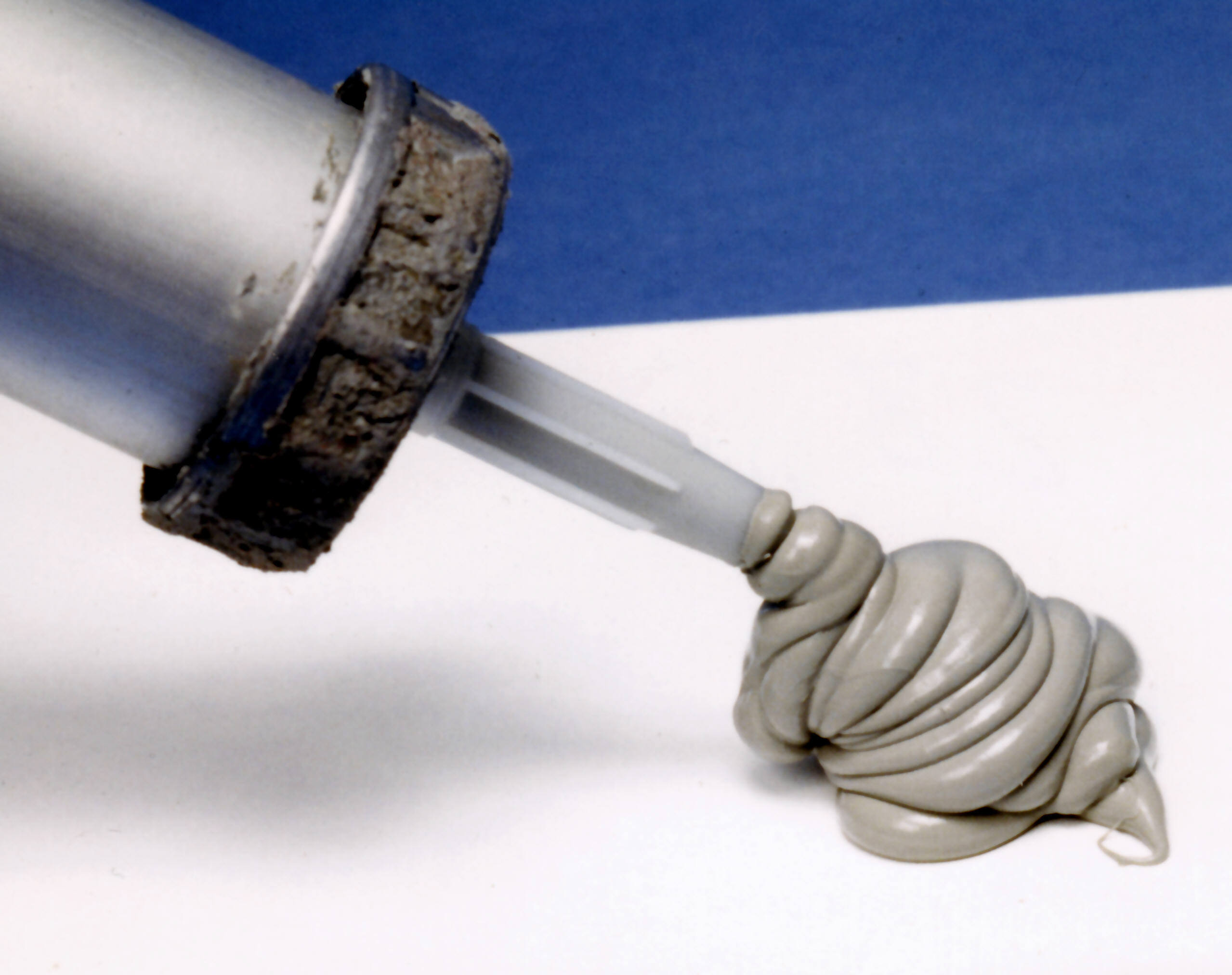
Silicones are typically heat-resistant and rubber-like, and are used in sealants, adhesives, lubricants, medicine, cooking utensils, and thermal and electrical insulation. Some common forms include silicone oil, silicone grease, silicone rubber, silicone resin, and silicone caulk. Compared to methyl-based silicones, phenyl-based silicones have higher oxidation resistance, thermal stability and shear resistance. At elevated temperatures, phenyl-based silicones are more stable and resistant to thermal and oxidizing attack.

Monday, February 2, 2015

Health Risks from Inhaled Polychlorinated Biphenyls


Evaluating Health Risks from Inhaled Polychlorinated Biphenyls: Research Needs for Addressing Uncertainty


A recent article published in Environ Health Perspect by Lehmann et al. DOI:10.1289/ehp.1408564 describes some common sources of PCBs in indoor air and estimate the contribution of inhalation exposure to total PCB exposure for select age groups and identified some critical areas of research needed to improve assessment of exposure and exposure response for inhaled PCBs.

Air concentrations of polychlorinated biphenyls (PCBs) in some buildings can be orders of magnitude higher than background levels. The potential health risk posed by PCBs from indoor environment need to be assessed. To assess such risk we need to face some uncertainty.

Previous assessments of exposure and risk associated with PCBs primarily focused on dietary intake of contaminated food. With many recent studies suggested the importance of indoor PCB exposure, this article points out one important uncertainty for risk assessment of PCBs from indoor exposure.

The distributions of  PCB congeners in food and in indoor air are quite different. As such, toxicity of of PCB mixtures from indoor environment is likely to be different from toxicity due to dietary intake.

In addition to the uncertainty mentioned in the article, I think another uncertainty we need to face lies in the pathway from external exposure to internal exposure. Bioavailability/toxicokinetics of PCBs from inhalation would be quite different from dietary intake and need to be addressed.


Wednesday, January 21, 2015

Inert Ingredients of Pesticides

Besides active ingredients that kill insects, rodents, or weeds, chemicals in pesticide also include the so-called inert ingredients—chemicals in pesticides that perform functions other than controlling pests.

Examples of inert ingredients are emulsifiers, solvents, aerosols, fragrances and dyes. Many pesticides companies treat information on inert ingredients of their products as proprietary and are not willing to disclose such ingredients. Therefore, no health and safety information about the inert ingredients that are already on the market.

However, pesticide manufacturers and the Environmental Protection Agency are in the pressure from consumers and environmental advocacy groups to reveal all of the chemicals in pesticide formulations, including the inert ingredients. Let's see what actions will be taken by pesticide manufacturers and the Environmental Protection Agency under such pressure.

More info: http://cen.acs.org/articles/93/i2/Pesticide-Industry-Stands-Firm-Amid.html