Saturday, February 14, 2015

Caffeine chemistry

Caffeine, a methylxanthine alkaloid  closely shares chemical structural features with the adenine and guanine contained in deoxyribonucleic acid (DNA).

caffeine


adenine                                     guanine


Caffeine is the world's most widely consumed psychoactive substances, but unlike many others, it is legal and unregulated in nearly all parts of the world.  Caffeine is classified as "generally recognized as safe" (GRAS) with toxic doses, over 10 grams per day for an adult. A cup  of coffee contains 100–200 mg of caffeine.

Caffeine can have both positive and negative health effects. It may confer a modest protective effect against some diseases, including Parkinson's disease and cardiovascular disease such as coronary artery disease and stroke. On the other hand, caffeine can cause sleep disruption, headaches, irritability, increased blood pressure and heart rate.

Decaffeination (decaf) is applied to remove caffeine from coffee beans, cocoa, tea leaves and other caffeine-containing materials. Decaffeinated drinks contain typically 1–2% of the original caffeine content, and sometimes as much as 20%.

In all decaffeination processes, coffee is always decaffeinated in its green, unroasted state. The greatest challenge to the decaffeination process is to try to separate only the caffeine from the coffee beans while leaving the other chemicals such as sucrose, cellulose, proteins, citric acid, tartaric acid, and formic acid at their original concentrations.  Since caffeine is a polar, water-soluble substance, water is used in all forms of decaffeination. However, water alone is not the best solution for decaffeination because it is not a selective solvent and therefore removes other soluble substances, including sugars and proteins, as well as caffeine. Therefore decaffeination processes use a decaffeinating agent such as methylene chloride, activated charcoal, CO2, or ethyl acetate.

Plastic Pollution in the World's Oceans


Plastic Pollution in the World's Oceans: More than 5 Trillion Plastic Pieces Weighing over 250,000 Tons Afloat at Sea.

A paper published in Science today on the estimation of mass of land-based plastic waste entering the ocean by linking worldwide data on solid waste, population density, and economic status. It is estimated that 275 million metric tons (MT) of plastic waste was generated in 192 coastal countries in 2010, with 4.8 to 12.7 million MT entering the ocean. Population size and the quality of waste management systems largely determine which countries contribute the greatest mass of uncaptured waste available to become plastic marine debris. Without waste management infrastructure improvements, the cumulative quantity of plastic waste available to enter the ocean from land is predicted to increase by an order of magnitude by 2025.

More information in the Report published in Science: http://www.sciencemag.org/content/347/6223/768.abstract
source of the graph:http://news.uga.edu/documents/infographic-final.pdf

Tuesday, February 10, 2015

Chemicals used for vector control


DDT has been used in malaria vector control because of its long residual efficacy when sprayed on walls and ceilings (6–12 months depending on dosage and nature of substrate).

Vector control is a method to limit or eradicate the mammals, birds, insects or other arthropods which transmit disease pathogens. The most frequent type of vector control is mosquito control using a variety of strategies.

DDT has been listed in the Stockholm Convention for persistent organic pollutants for international control. Recognizing that total elimination in many malaria-prone countries is currently unfeasible because there are few affordable or effective alternatives, the convention exempts public health use within World Health Organization (WHO) guidelines from the ban.

Today, about 3,000 to 4,000 tonnes of DDT are produced each year for vector control. DDT is applied to the inside walls of homes to kill or repel mosquitoes. This intervention, called indoor residual spraying (IRS), greatly reduces environmental damage. It also reduces the incidence of DDT resistance.
DDT (dichlorodiphenyltrichloroethane)

Reference
http://www.chem.unep.ch/DDT/documents/WHO_FAQonDDT.pdf
http://whqlibdoc.who.int/hq/2011/WHO_HTM_GMP_2011_eng.pdf
http://en.wikipedia.org/wiki/DDT
http://www.epa.gov/airquality/community/details/i-pesticides.html


Saturday, February 7, 2015

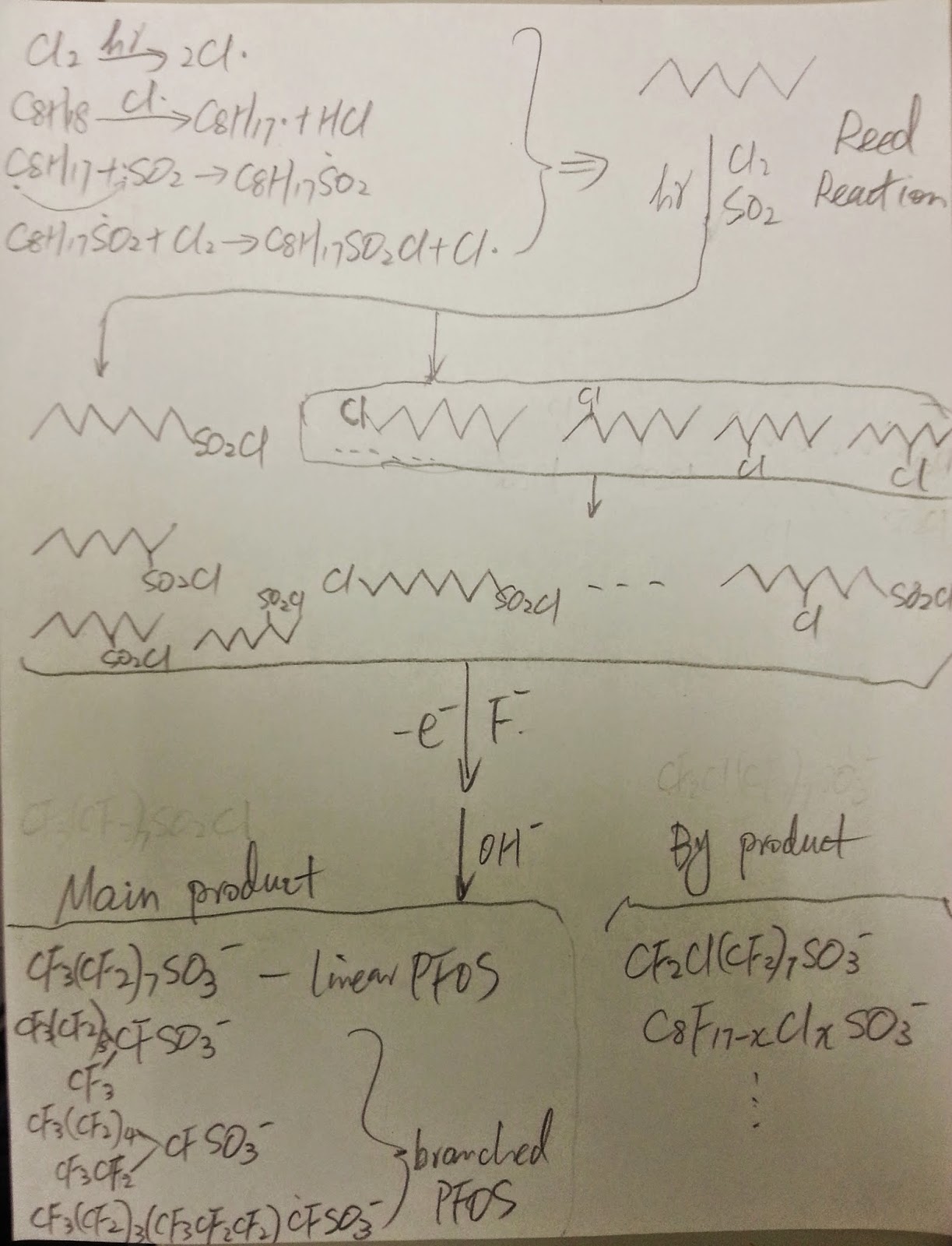
Chlorofluorooctane sulfanate (ClFOS or Cl-PFOS) : metabolites or by-product during the production of perfluorooctane sulfanate?

Researchers from the National Research Centre for Environmental Toxicology of Australia used liquid chromatography quadrupole time-of-flight tandem mass spectrometry found some novel fluorinated surfactants in firefighters. The study was published this week at Environmental Science and Technology.

One of the novel chemicals is chlorofluorooctane sulfanate (ClFOS or Cl-PFOS), or one F atom in PFOS get replaced with Cl.

One hypothesis for the origin of Cl-PFOS is due to metabolism of PFOS-related compounds in human body.

On the other hand,  I think it is plausible that the novel chlorofluorooctane sulfanate is a by-product during the production of PFOS.  Check the analysis of chemical reactions during the production of PFOS:


Thursday, February 5, 2015

Polychlorinated biphenyls (PCBs) in silicone-based adhesives and chlorophenylsilanes

Chlorophenylsilanes are the intermediate substances in the manufacturing of phenyl silicones. As suggested by evidence found in a recent study by Katsunori Anezaki,Takeshi Nakano
polychlorinated biphenyls (PCBs) could be formed along with reactions to synthesize
phenyl silicone.
Silicones are typically heat-resistant and rubber-like, and are used in sealants, adhesives, lubricants, medicine, cooking utensils, and thermal and electrical insulation. Some common forms include silicone oil, silicone grease, silicone rubber, silicone resin, and silicone caulk. Compared to methyl-based silicones, phenyl-based silicones have higher oxidation resistance, thermal stability and shear resistance. At elevated temperatures, phenyl-based silicones are more stable and resistant to thermal and oxidizing attack.

Wednesday, February 4, 2015

Historical used organochlorine termiticides

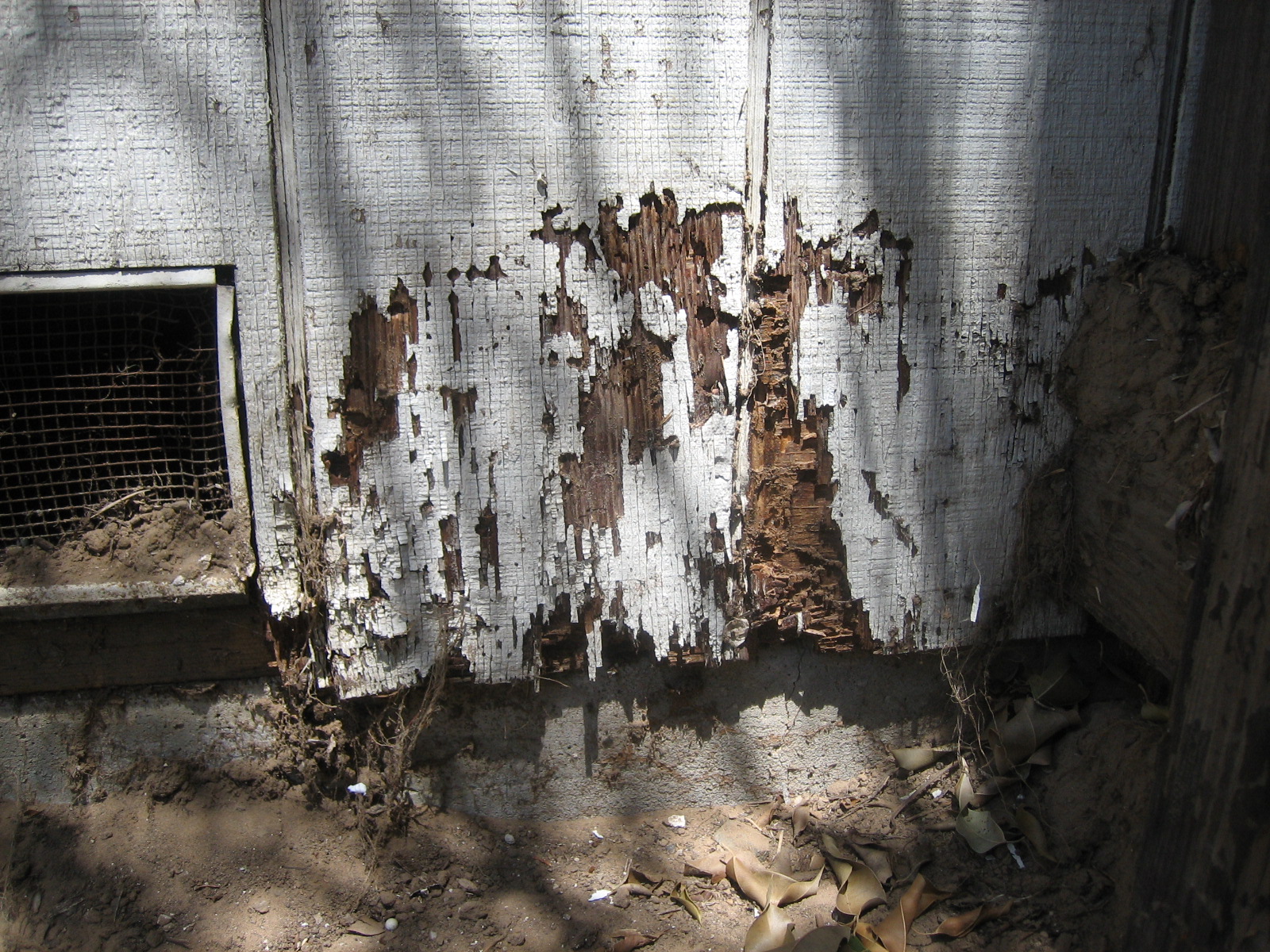
Organochlorine termiticides are a group of pesticides that were used for termite control in and around wooden buildings and homes from the mid-1940s to the late 1980s. These organochlorine pesticides included chlordane, aldrin, dieldrin, heptachlor, and dichlorodiphenyltrichloroethane (DDT). They
were used primarily by pest control operators in tropical urban areas, but also by homeowners, the military, the state, and counties to protect buildings against termite damage.


Chlordane as one of the most widely used termiticide before 1980s


In the 1970s and 1980s, the U.S. Environmental Protection Agency (EPA) banned all uses of these organochlorine pesticides except for heptachlor, which can be used today only for control of fire ants in underground power transformers.

Termiticides were commonly applied directly to soil beneath buildings or beneath slab foundations and around the foundation perimeter for new construction. They may also have been periodically applied underneath the building (if accessible) at occupied structures, around the perimeter of the foundation, or in trenches excavated around the foundation, or by injection through holes drilled next to the foundation or in the flooring at the periphery of walls.

These pesticides break down slowly in the environment, application rates were relatively high, and applications may have been repeated over time. As a result, these organochlorine termiticides may sometimes still be found in treated soils. The organochlorine termiticides contaminated soil becomes secondary source of the chemicals in he air.


Recommended  actions to limit or avoid exposure include:
 Plant grass or other non-edible vegetation
 Cover contaminated soil with some kind of surface material such as gravel (within several feet of the foundation) to act as a barrier to prevent soil exposure.
 Keep children from playing in dirt near the foundation and keep toys, pacifiers, and other items that go into children’s mouths clean.
 Locate pet enclosures away from the perimeter of the building foundation.
 Do not grow edible produce such as fruits and vegetables in potentially contaminated soils next to the building foundation. Cover the soil next to the foundation, or add clean soil and landscape with non-edible plants.
 Do not relocate soils from underneath the building or from the foundation perimeter to other areas of the property.
 To reduce exposure to soil, cover bare soil underneath the house with a barrier material such as gravel or plastic before you work or store materials underneath the house.

 Wash hands and face thoroughly after you work or play in soil near the building foundation, especially before meals and snacks.
 Avoid tracking soil from near the foundation perimeter into the home and clean it up right away if soil is tracked in. Remove work and play shoes before you enter the house. Keep pets from tracking
contaminated soil into your home.
 If you work with contaminated soil or soil that may be contaminated, you should wear gloves and
protective clothing (long-sleeve shirt and pants) to reduce exposure. A protective paper mask (N-95 type with two elastic straps) should be worn if airborne dust is present (such as when you are operating a weed-eater in contaminated or potentially contaminated areas). Working with contaminated soil may leave residues on your clothing, so change clothes and shower after you work with the soil and avoid spreading dirt from clothes or shoes into your vehicle or house.

Information retrieved from
http://eha-web.doh.hawaii.gov/eha-cma/Downloads/HEER/termiticidefactsheetfinalsept2011.pdf



Tuesday, February 3, 2015

UN Calls for Wastewater Focus

In my research, I focus on toxic chemicals that cannot be removed from wastewater treatment. And a lot of studies aim to develop advanced wastewater treatment technologies to remove more toxic chemicals in order to reduce loadings of toxic chemicals to the environment, which would affect ecosystems and in turn human health.

IMG_4994

While developed countries such as Canada and the USA have over 90% of wastewater treated, sanitation of wastewater is still a big challenge faced by many low-income countries.  The global data indicate that only 20% of global wastewater is currently being treated. Wastewater in some developing countries is barely treated before released to the environment. Low-income countries possessing only 8 per cent of the required capacity to treat wastewater effectively. Such untreated wastewater is likely to contaminate water supplies and cause diseases. A UN-Water Analytical Brief, produced by the World Health Organization (WHO), the United Nations Environment Programme (UNEP) and UN-Habitat, on behalf of UN-Water, describes the damage being done to ecosystems and biodiversity as 'dire' and warns of the threat wastewater will increasingly pose to human health, economic activity, and water security if left unaddressed.

It is obvious that sustainable wastewater management will become a key task for the world to apply in the coming years.

UN and WHO officials pointed out  "Wastewater management has been neglected in the rush to commercialize drinking water production, a situation exacerbated by a fragmented water management system in many countries, and the use of different technologies that are often designed separately and retrofitted to existing systems."

"Around 70 per cent of industrial discharge in developing countries goes untreated. And eutrophication - from wastewater and agricultural run-off - has, according to recent estimates, reduced biodiversity in rivers, lakes and wetlands by about one-third globally."

"It is time to turn this environmental and human health challenge into an opportunity. Agriculture consumes 70 per cent of global water withdrawal, but agricultural irrigation from reclaimed wastewater is on the rise, and is being used to irrigate 20 to 45 million hectares worldwide. This is just a fraction of what is possible if policy and available technologies converge to ensure that wastewater and water quality are fully integrated into a more holistic water agenda as part of the post-2015 process,"

"To be successful and sustainable, wastewater management must be an integral part of the critical levers of urban planning and legislation resulting in productive, healthy and livable cities. The upcoming UN Conference on Housing and Sustainable Urban Development, Habitat III, will be an opportunity to underscore the importance of effective wastewater management and highlight the role of wastewater in the new urban agenda."

References and read more:
www.unwater.org/publications/publications-detail/en/c/275896/
http://www.unep.org/newscentre/Default.aspx?DocumentID=2818&ArticleID=11130&l=en#sthash.KH72aIVy.dpuf